Logo on colored background

Pothana

About the Piece

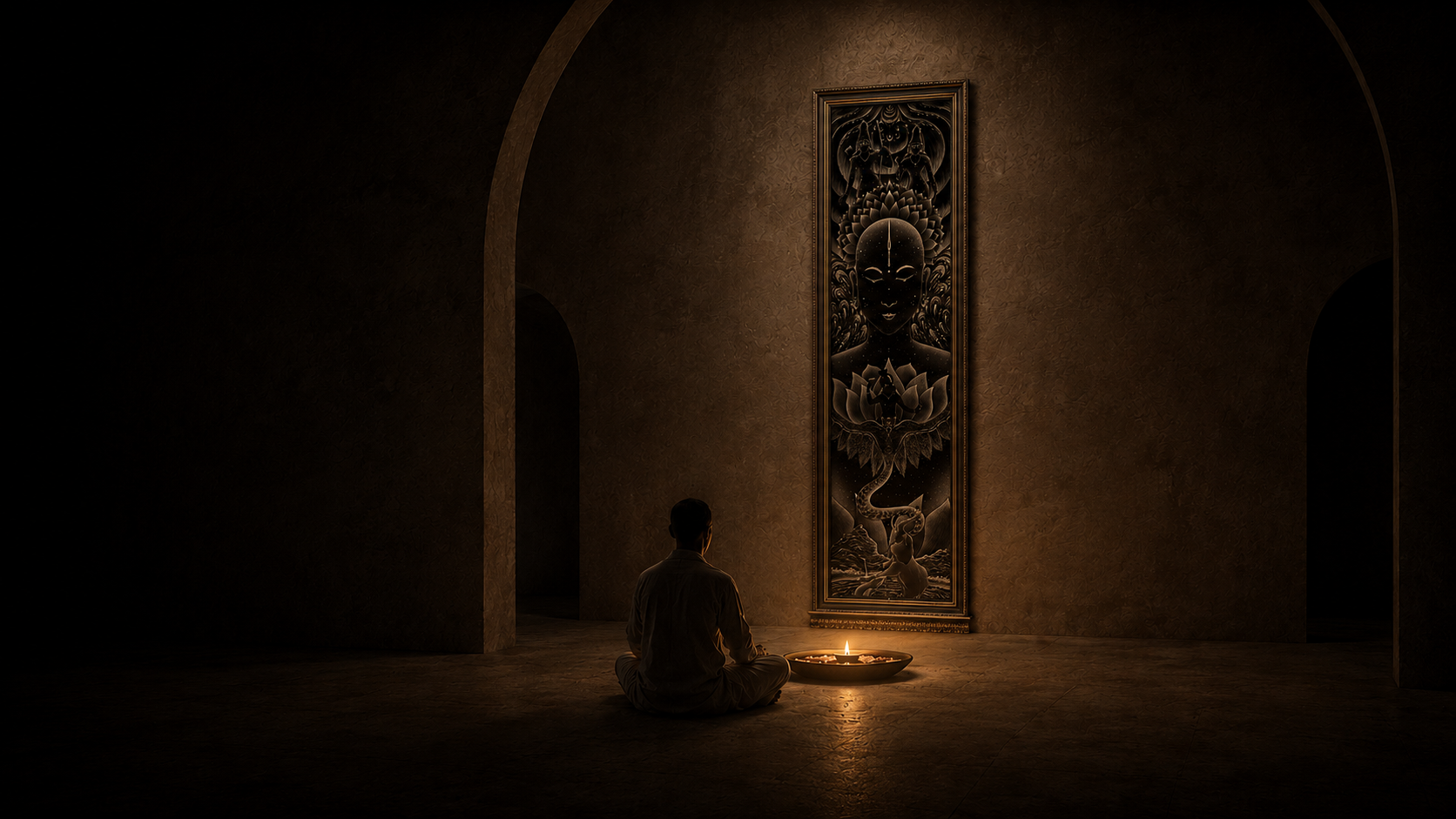
In the realm of timeless wisdom, the ethereal strokes of Sage Pothana unveil the sacred drama of Gajendra Moksham — an enigmatic dance between consciousness and divinity. At the heart of this cosmic portrayal, the elephant and the crocodile, symbolic avatars of the Kari and Makari, engage in a primal struggle within the sacred realms of Mooladhara. Reflected by four ethereal petals, this cosmic choreography represents the battleground of personality and ego, a testament to the eternal conflict within.

As the narrative unfolds, the symbolic metamorphosis commences, guided by the serpentine path that transcends earthly binds. The serpent, a mystical ally, transforms into the majestic eagle, an emissary of consciousness reached through the sacred breath. At the helm of this celestial journey stands the lord astride the eagle, anointed at the Anahatha—the heart center of Pothana’s creation.

Yet, this transcendent odyssey is not a solo expedition; it unfolds under the watchful gaze and divine guidance of Lord Rama and Mother Seetha, embodiments of the absolute divine consciousness residing within the Sahasrara—the 1000 Petal Lotus. Their omnipresence infuses purpose into the unfolding drama, orchestrating the ascent from the earthly Mooladhara to the celestial Sahasrara.

Gajendra, the noble elephant, becomes the living allegory of absolute surrender—a poignant hymn echoing through the ages. In the crescendo of vulnerability, the lord descends to rescue, illustrating how, in the depths of despair, the devout find salvation through unwavering surrender.

This saga, rich with spiritual resonance, narrates the tale of ego’s demise—a transformative ballet where the lord, in divine benevolence, rescues devotees from the abyss of despair. It is a reminder that even when all seems lost, true surrender is the key that unlocks the gates of divine intervention.

Within the mystical creation of Pothana, the awakening of Kundalini emerges as a sacred symphony. The personality unfurls from the Mooladhara to the Sahasrara, riding on the breath and the serpent, as the lord, perched atop the crown, commands this ascent with celestial authority.

In every stroke, Gajendra Moksham becomes a masterpiece of spiritual revelation—an artistic rendering of the eternal dance between mortal surrender and divine salvation, etched on the canvas of existence.

The Genisis

సిరికింజెప్పడు; శంఖ చక్రయుగముం జేదోయి సంధింపడు; పరివారంబును జీర డభగ్రపతిం బన్ని ంపడాకర్ణికాంతర ధమ్మి ల్లముఁ జక్క నొత్తడు; వివాదప్రోత్థితశ్రీకుచో పరిచేలాంచలమైన వీడడు గజప్రాణావనోత్సా హియై

లావొక్కింతయు లేదు ధైర్యము విలోలంబయ్యె; బ్రాణంబులున్ ఠావుల్ దప్పెను; మూర్ఛ వచ్చె; తనువున్ డస్సెన్; శమ్ర ంబయ్యెడిన్ నీవేతప్ప ఇతంాన్ పరంబెఱుగ; మన్ని ంపందగున్ దీనునిన్ రావేఈశ్వర! కావవేవరద! సంరక్షించు భద్రాత్మకా!

Sirikim Jeppadu Samka Cakra Yugamum Cedoyi Samdhimpa De

Parivarambunu Jira Dabragapatin Mannimpada Karnikam

Tara Dhammillamu Cakkanottadu Vivada Proddhita Sri Kuco

Pari Celamcalamaina Vidadu Hari Gajaprana Vanotsahi Yai


Lavokkintayu Ledu Dhairyamu Vilolambayye Branamulun

Tavul Dappenu Murchavachhe Danuvun Dassen Sramambayyedin

Neeve Tappa Nitah Paramberuga Mannipandagun Deenunin

Rave Eeswara Kavave Varada Samrakshinchu Bhadratmaka

Note:

These texts are the foundation from which the paintings were born. Spending time with them through contemplation and meditation can help the deeper layers of the artwork reveal themselves.

The paintings are not meant to be understood only visually, but experientially. Like all sacred art, they unfold more completely when approached with inner practice and reflection.

For a fuller understanding of the symbolism and spirit behind the work, please take the time to read, contemplate, and sit with these texts.

"The key idea: Can you give when you need the most? That's the hardest thing. Offering is not about flowers — it's about willingness. If you're not willing, nothing works."

Spatial Effect

Pothana is the most upliftingly humbling painting of the series, and at the same time, the most magnanimous. Where Rudram brings intensity and stillness, where Tirumala brings grace and ease, Pothana brings two qualities held inseparably together — the fierce tenderness of surrender, and the vast, expansive largeness of life that arrives when one learns to offer. It is the longest, the most demanding, the most transformative of the three. Black holds it. Within that black, the entire ascent of consciousness is mapped from the base of the body to the crown.

A room living with this painting becomes a room that quietly invites its inhabitants to outgrow themselves. The painting carries the weight of Gajendra’s offering — the moment when fight gives way to giving, when asking gives way to surrender — and that weight reorganises the gravity of the space, gently guiding it toward something higher. The painting does not only humble. It opens. The same canvas that asks for surrender also reveals the grandeur waiting on the other side of it — the breadth of life, the abundance of grace, the sheer largeness that descends upon the one who has learned to give. Offering and grandeur are not opposites here. They are the same gesture, seen from two ends.

There is a nature of fire to this painting that is unlike the others. It carries an intensity that the surrounding material can sometimes struggle to hold. It is best placed in rooms made for serious sitting, serious thinking, serious surrender — meditation spaces, sadhana rooms, the inward chambers of a home where the deepest work is welcomed. Where it is placed, it works without ceremony. The lit lamp is enough.

Effect on The Person

The painting trains the eye to see the Lord through the elements of nature. The calendar version of God already exists in high fidelity — drawn endlessly, prayed to daily. Tirumala does the quieter, more elemental work. It asks the viewer to look at the next cloud, the next strike of lightning, the next stretch of dry land, the next flowing river, and find the divine already placed there. The Lord moves through the elements; the painting only points to where he is already standing.

This is the elemental play of Vishnu — present in the rain that fills the cloud, in the light that splits it, in the hill that rises beneath it, in the water that runs below it. The composition does not draw the Lord directly. The cloud is drawn, the lightning is drawn, the hills are drawn — and the form emerges within them. Anyone drawn to Venkateshwara Swami will recognise this painting immediately, but its work is wider than that single recognition. It is grace, made visible.

01 A profound and unsought humility

The painting humbles whoever lives with it. The moment the viewer thinks “I understand this now,” the painting closes itself. Only when the thought is dropped does it open again. Over time, this rhythm trains a different posture in the body — not the posture of mastery, but the posture of receiving. The one who lives with this painting learns, slowly, that mastery was never the point. Surrender was. And from surrender, life expands rather than contracts.

02 The dissolution of ego’s inhibitions

This is the painting’s quiet, transformative work. Layer by layer, day by day, the small holdings of the self begin to loosen — the defensive grips, the pride of position, the fear of being seen as small, the inhibitions that keep a life narrow. The painting does not strip these away forcibly. It draws the viewer upward, and the inhibitions release on their own as the ascent continues. What was once a tight, guarded posture becomes a wider, freer one. The ego does not vanish. It simply stops standing in the way.

03 The mapping of the entire body as a path of ascent

Read from bottom to top, the painting is the ascent of consciousness. The four petals at the base are the Mooladhara, the cosmic battleground of personality and ego. The struggle of the elephant and the crocodile is the daily encounter with inhibition and identity. The serpent transforms into the eagle, and the Kundalini rises on the breath. The Lord, perched at the Anahata — the heart centre — commands the ascent. Above, at the Sahasrara, Rama and Sita preside as the absolute divine consciousness. Read from top to bottom, the painting is descent — the way grace travels from the crown into the body, into the breath, into the flesh, into the moment of offering. The two readings meet at the heart, where the Lord receives the offering and grants the rescue.

04 The teaching of offering as the highest act

Gajendra fights. Gajendra tires. Gajendra calls for help and is met with silence. Only when Gajendra stops asking and begins to offer — lifting a lotus from a pool of his own blood — does the Lord descend. The painting holds this single principle on the wall: the universe responds not to the loudness of the asking, but to the truth of the offering. The minimum one can offer is one’s time, one’s intent, one’s willingness to be open. Living with this painting strengthens, day by day, the quiet capacity to give when one feels one has nothing left. And it reveals, over time, the secret it carries — that offering does not deplete a life. It magnifies it.

05 The grandeur and largeness of a life lived in offering

This is the painting’s hidden second gift, and the one most often missed. Surrender does not shrink a life. It enlarges it. The one who learns to offer — quietly, faithfully, without bargaining — finds that life becomes vaster, not smaller. Doors open that effort could not have opened. Resources arrive without being chased. Capacity expands. The universe bends toward those who have stopped trying to hold it. The painting holds this truth alongside the truth of surrender, because the two are inseparable. Magnanimity is what offering produces. Largeness is the form grace takes in the world.

06 Grace as the foundation of existence

Gajendra fights. Gajendra tires. Gajendra calls for help and is met with silence. Only when Gajendra stops asking and begins to offer — lifting a lotus from a pool of his own blood — does the Lord descend. The painting holds this single principle on the wall: the universe responds not to the loudness of the asking, but to the truth of the offering. The minimum one can offer is one’s time, one’s intent, one’s willingness to be open. Living with this painting strengthens, day by day, the quiet capacity to give when one feels one has nothing left. And it reveals, over time, the secret it carries — that offering does not deplete a life. It magnifies it.

What it Does for Specific Kinds of People

01 Anyone whose practice is rooted in surrender

For devotees of Rama, Krishna, Vishnu in any form, or any path whose foundation is the act of offering — Pothana is the painting that holds the entire philosophy of surrender on a single wall. Kundalini practitioners, those working with the chakra system, those engaged with the breath as a path of ascent — for all of them, this painting is functionally a map of the work itself.

02 Researchers and people doing deep mental work

For those caught in the long fight — with a circumstance, a relationship, an illness, an inner difficulty that will not yield to effort. The painting does not promise rescue. It teaches the deeper truth: that grace arrives when the fighting ends, and that what arrives is larger than what was being fought for. It does not soften the difficulty; it reframes it, gently, into the possibility of offering — and the largeness that follows from it.

03 Those ready to outgrow themselves

For those who have lived enough to know that mastery is an illusion, that competence is a small thing, that the deepest growth happens only when the self is willing to expand beyond its current shape. The painting does this work quietly and continuously. It lifts the viewer past the inhibitions that have kept life narrow, and into the openness that has been waiting all along. Both postures are kept alive: the humility that lets one bend, and the largeness that rises through that bending.

04 Sadhana spaces, meditation rooms, and inward chambers of the home

The painting is best placed where serious work happens — the corner of a home where one sits in silence, the room where practice is undertaken without interruption, the private space where the layers of self can be lifted and the largeness of grace can be received in private

05 Children, in a different way

A child who grows up looking at this painting, wondering what it means, is being shaped by it without knowing. The wondering is the practice. The humility, the awe, the awareness that there is something larger — and that one becomes large by bowing to it — these settle into the child’s understanding long before language can name them.

The Essence in a Nutshell

Pothana gives you, on your wall, the answer to the hardest question a human being can carry: can you give when you most need to receive — and can you trust the largeness that comes when you do?

The painting holds the entire teaching of Gajendra Moksham in a single vertical canvas. Struggle gives way to exhaustion. Exhaustion gives way to questioning. Questioning gives way to surrender. Surrender gives way to offering. And offering — the willingness to give when one believes one has nothing left — is what bends the universe. The Lord breaks his own cosmic protocol to descend the moment that offering becomes real. He does not come quietly. He comes vast, breaking the rules of his own descent, arriving with the full grandeur of grace.

This is the deepest gift of the painting. It does not teach effort. It teaches the end of effort. It does not promise comfort. It promises growth — the steady, upward expansion of a life that has learned to outgrow its own inhibitions and step into the largeness waiting on the other side. Grace — undeserved, unconditional, and magnanimous — is what arrives in that opening. And the life lived inside that grace is not a smaller life. It is a vaster one. Surrender is the door through which the largeness of existence enters.

Living with this painting changes the posture of a life. Humility deepens. The grip of self loosens. The capacity to offer — quietly, daily, without expectation — begins to grow. And slowly, the truth the painting holds becomes the truth one lives by: that grace is the foundation of everything, that surrender is the only door through which it enters, and that what arrives when it enters is the full magnanimity of the universe itself.

"Grace. Undeserved. Unconditional. But it comes when offering becomes real. When you stop asking — and start giving. That's when the universe bends."

Logo on colored background

Pothana

About the Piece

In the realm of timeless wisdom, the ethereal strokes of Sage Pothana unveil the sacred drama of Gajendra Moksham — an enigmatic dance between consciousness and divinity. At the heart of this cosmic portrayal, the elephant and the crocodile, symbolic avatars of the Kari and Makari, engage in a primal struggle within the sacred realms of Mooladhara. Reflected by four ethereal petals, this cosmic choreography represents the battleground of personality and ego, a testament to the eternal conflict within.

As the narrative unfolds, the symbolic metamorphosis commences, guided by the serpentine path that transcends earthly binds. The serpent, a mystical ally, transforms into the majestic eagle, an emissary of consciousness reached through the sacred breath. At the helm of this celestial journey stands the lord astride the eagle, anointed at the Anahatha—the heart center of Pothana’s creation.

Yet, this transcendent odyssey is not a solo expedition; it unfolds under the watchful gaze and divine guidance of Lord Rama and Mother Seetha, embodiments of the absolute divine consciousness residing within the Sahasrara—the 1000 Petal Lotus. Their omnipresence infuses purpose into the unfolding drama, orchestrating the ascent from the earthly Mooladhara to the celestial Sahasrara.

Gajendra, the noble elephant, becomes the living allegory of absolute surrender—a poignant hymn echoing through the ages. In the crescendo of vulnerability, the lord descends to rescue, illustrating how, in the depths of despair, the devout find salvation through unwavering surrender.

This saga, rich with spiritual resonance, narrates the tale of ego’s demise—a transformative ballet where the lord, in divine benevolence, rescues devotees from the abyss of despair. It is a reminder that even when all seems lost, true surrender is the key that unlocks the gates of divine intervention.

Within the mystical creation of Pothana, the awakening of Kundalini emerges as a sacred symphony. The personality unfurls from the Mooladhara to the Sahasrara, riding on the breath and the serpent, as the lord, perched atop the crown, commands this ascent with celestial authority.

In every stroke, Gajendra Moksham becomes a masterpiece of spiritual revelation—an artistic rendering of the eternal dance between mortal surrender and divine salvation, etched on the canvas of existence.

The Genisis

సిరికింజెప్పడు; శంఖ చక్రయుగముం జేదోయి సంధింపడు; పరివారంబును జీర డభగ్రపతిం బన్ని ంపడాకర్ణికాంతర ధమ్మి ల్లముఁ జక్క నొత్తడు; వివాదప్రోత్థితశ్రీకుచో పరిచేలాంచలమైన వీడడు గజప్రాణావనోత్సా హియై

లావొక్కింతయు లేదు ధైర్యము విలోలంబయ్యె; బ్రాణంబులున్ ఠావుల్ దప్పెను; మూర్ఛ వచ్చె; తనువున్ డస్సెన్; శమ్ర ంబయ్యెడిన్ నీవేతప్ప ఇతంాన్ పరంబెఱుగ; మన్ని ంపందగున్ దీనునిన్ రావేఈశ్వర! కావవేవరద! సంరక్షించు భద్రాత్మకా!

Sirikim Jeppadu Samka Cakra Yugamum Cedoyi Samdhimpa De

Parivarambunu Jira Dabragapatin Mannimpada Karnikam

Tara Dhammillamu Cakkanottadu Vivada Proddhita Sri Kuco

Pari Celamcalamaina Vidadu Hari Gajaprana Vanotsahi Yai


Lavokkintayu Ledu Dhairyamu Vilolambayye Branamulun

Tavul Dappenu Murchavachhe Danuvun Dassen Sramambayyedin

Neeve Tappa Nitah Paramberuga Mannipandagun Deenunin

Rave Eeswara Kavave Varada Samrakshinchu Bhadratmaka

Note:

These texts are the foundation from which the paintings were born. Spending time with them through contemplation and meditation can help the deeper layers of the artwork reveal themselves.

The paintings are not meant to be understood only visually, but experientially. Like all sacred art, they unfold more completely when approached with inner practice and reflection.

For a fuller understanding of the symbolism and spirit behind the work, please take the time to read, contemplate, and sit with these texts.

"The key idea: Can you give when you need the most? That's the hardest thing. Offering is not about flowers — it's about willingness. If you're not willing, nothing works."

Spatial Effect

Pothana is the most upliftingly humbling painting of the series, and at the same time, the most magnanimous. Where Rudram brings intensity and stillness, where Tirumala brings grace and ease, Pothana brings two qualities held inseparably together — the fierce tenderness of surrender, and the vast, expansive largeness of life that arrives when one learns to offer. It is the longest, the most demanding, the most transformative of the three. Black holds it. Within that black, the entire ascent of consciousness is mapped from the base of the body to the crown.

A room living with this painting becomes a room that quietly invites its inhabitants to outgrow themselves. The painting carries the weight of Gajendra’s offering — the moment when fight gives way to giving, when asking gives way to surrender — and that weight reorganises the gravity of the space, gently guiding it toward something higher. The painting does not only humble. It opens. The same canvas that asks for surrender also reveals the grandeur waiting on the other side of it — the breadth of life, the abundance of grace, the sheer largeness that descends upon the one who has learned to give. Offering and grandeur are not opposites here. They are the same gesture, seen from two ends.

There is a nature of fire to this painting that is unlike the others. It carries an intensity that the surrounding material can sometimes struggle to hold. It is best placed in rooms made for serious sitting, serious thinking, serious surrender — meditation spaces, sadhana rooms, the inward chambers of a home where the deepest work is welcomed. Where it is placed, it works without ceremony. The lit lamp is enough.

Effect on The Person

The painting trains the eye to see the Lord through the elements of nature. The calendar version of God already exists in high fidelity — drawn endlessly, prayed to daily. Tirumala does the quieter, more elemental work. It asks the viewer to look at the next cloud, the next strike of lightning, the next stretch of dry land, the next flowing river, and find the divine already placed there. The Lord moves through the elements; the painting only points to where he is already standing.

This is the elemental play of Vishnu — present in the rain that fills the cloud, in the light that splits it, in the hill that rises beneath it, in the water that runs below it. The composition does not draw the Lord directly. The cloud is drawn, the lightning is drawn, the hills are drawn — and the form emerges within them. Anyone drawn to Venkateshwara Swami will recognise this painting immediately, but its work is wider than that single recognition. It is grace, made visible.

01 A profound and unsought humility

The painting humbles whoever lives with it. The moment the viewer thinks “I understand this now,” the painting closes itself. Only when the thought is dropped does it open again. Over time, this rhythm trains a different posture in the body — not the posture of mastery, but the posture of receiving. The one who lives with this painting learns, slowly, that mastery was never the point. Surrender was. And from surrender, life expands rather than contracts.

02 The dissolution of ego’s inhibitions

This is the painting’s quiet, transformative work. Layer by layer, day by day, the small holdings of the self begin to loosen — the defensive grips, the pride of position, the fear of being seen as small, the inhibitions that keep a life narrow. The painting does not strip these away forcibly. It draws the viewer upward, and the inhibitions release on their own as the ascent continues. What was once a tight, guarded posture becomes a wider, freer one. The ego does not vanish. It simply stops standing in the way.

03 The mapping of the entire body as a path of ascent

Read from bottom to top, the painting is the ascent of consciousness. The four petals at the base are the Mooladhara, the cosmic battleground of personality and ego. The struggle of the elephant and the crocodile is the daily encounter with inhibition and identity. The serpent transforms into the eagle, and the Kundalini rises on the breath. The Lord, perched at the Anahata — the heart centre — commands the ascent. Above, at the Sahasrara, Rama and Sita preside as the absolute divine consciousness. Read from top to bottom, the painting is descent — the way grace travels from the crown into the body, into the breath, into the flesh, into the moment of offering. The two readings meet at the heart, where the Lord receives the offering and grants the rescue.

04 The teaching of offering as the highest act

Gajendra fights. Gajendra tires. Gajendra calls for help and is met with silence. Only when Gajendra stops asking and begins to offer — lifting a lotus from a pool of his own blood — does the Lord descend. The painting holds this single principle on the wall: the universe responds not to the loudness of the asking, but to the truth of the offering. The minimum one can offer is one’s time, one’s intent, one’s willingness to be open. Living with this painting strengthens, day by day, the quiet capacity to give when one feels one has nothing left. And it reveals, over time, the secret it carries — that offering does not deplete a life. It magnifies it.

05 The grandeur and largeness of a life lived in offering

This is the painting’s hidden second gift, and the one most often missed. Surrender does not shrink a life. It enlarges it. The one who learns to offer — quietly, faithfully, without bargaining — finds that life becomes vaster, not smaller. Doors open that effort could not have opened. Resources arrive without being chased. Capacity expands. The universe bends toward those who have stopped trying to hold it. The painting holds this truth alongside the truth of surrender, because the two are inseparable. Magnanimity is what offering produces. Largeness is the form grace takes in the world.

06 Grace as the foundation of existence

Gajendra fights. Gajendra tires. Gajendra calls for help and is met with silence. Only when Gajendra stops asking and begins to offer — lifting a lotus from a pool of his own blood — does the Lord descend. The painting holds this single principle on the wall: the universe responds not to the loudness of the asking, but to the truth of the offering. The minimum one can offer is one’s time, one’s intent, one’s willingness to be open. Living with this painting strengthens, day by day, the quiet capacity to give when one feels one has nothing left. And it reveals, over time, the secret it carries — that offering does not deplete a life. It magnifies it.

What it Does for Specific Kinds of People

01 Anyone whose practice is rooted in surrender

For devotees of Rama, Krishna, Vishnu in any form, or any path whose foundation is the act of offering — Pothana is the painting that holds the entire philosophy of surrender on a single wall. Kundalini practitioners, those working with the chakra system, those engaged with the breath as a path of ascent — for all of them, this painting is functionally a map of the work itself.

02 Researchers and people doing deep mental work

For those caught in the long fight — with a circumstance, a relationship, an illness, an inner difficulty that will not yield to effort. The painting does not promise rescue. It teaches the deeper truth: that grace arrives when the fighting ends, and that what arrives is larger than what was being fought for. It does not soften the difficulty; it reframes it, gently, into the possibility of offering — and the largeness that follows from it.

03 Those ready to outgrow themselves

For those who have lived enough to know that mastery is an illusion, that competence is a small thing, that the deepest growth happens only when the self is willing to expand beyond its current shape. The painting does this work quietly and continuously. It lifts the viewer past the inhibitions that have kept life narrow, and into the openness that has been waiting all along. Both postures are kept alive: the humility that lets one bend, and the largeness that rises through that bending.

04 Sadhana spaces, meditation rooms, and inward chambers of the home

The painting is best placed where serious work happens — the corner of a home where one sits in silence, the room where practice is undertaken without interruption, the private space where the layers of self can be lifted and the largeness of grace can be received in private

05 Children, in a different way

A child who grows up looking at this painting, wondering what it means, is being shaped by it without knowing. The wondering is the practice. The humility, the awe, the awareness that there is something larger — and that one becomes large by bowing to it — these settle into the child’s understanding long before language can name them.

The Essence in a Nutshell

Pothana gives you, on your wall, the answer to the hardest question a human being can carry: can you give when you most need to receive — and can you trust the largeness that comes when you do?

The painting holds the entire teaching of Gajendra Moksham in a single vertical canvas. Struggle gives way to exhaustion. Exhaustion gives way to questioning. Questioning gives way to surrender. Surrender gives way to offering. And offering — the willingness to give when one believes one has nothing left — is what bends the universe. The Lord breaks his own cosmic protocol to descend the moment that offering becomes real. He does not come quietly. He comes vast, breaking the rules of his own descent, arriving with the full grandeur of grace.

This is the deepest gift of the painting. It does not teach effort. It teaches the end of effort. It does not promise comfort. It promises growth — the steady, upward expansion of a life that has learned to outgrow its own inhibitions and step into the largeness waiting on the other side. Grace — undeserved, unconditional, and magnanimous — is what arrives in that opening. And the life lived inside that grace is not a smaller life. It is a vaster one. Surrender is the door through which the largeness of existence enters.

Living with this painting changes the posture of a life. Humility deepens. The grip of self loosens. The capacity to offer — quietly, daily, without expectation — begins to grow. And slowly, the truth the painting holds becomes the truth one lives by: that grace is the foundation of everything, that surrender is the only door through which it enters, and that what arrives when it enters is the full magnanimity of the universe itself.

"Grace. Undeserved. Unconditional. But it comes when offering becomes real. When you stop asking — and start giving. That's when the universe bends."

Logo on colored background

Pothana

About the Piece

In the realm of timeless wisdom, the ethereal strokes of Sage Pothana unveil the sacred drama of Gajendra Moksham — an enigmatic dance between consciousness and divinity. At the heart of this cosmic portrayal, the elephant and the crocodile, symbolic avatars of the Kari and Makari, engage in a primal struggle within the sacred realms of Mooladhara. Reflected by four ethereal petals, this cosmic choreography represents the battleground of personality and ego, a testament to the eternal conflict within.

As the narrative unfolds, the symbolic metamorphosis commences, guided by the serpentine path that transcends earthly binds. The serpent, a mystical ally, transforms into the majestic eagle, an emissary of consciousness reached through the sacred breath. At the helm of this celestial journey stands the lord astride the eagle, anointed at the Anahatha—the heart center of Pothana’s creation.

Yet, this transcendent odyssey is not a solo expedition; it unfolds under the watchful gaze and divine guidance of Lord Rama and Mother Seetha, embodiments of the absolute divine consciousness residing within the Sahasrara—the 1000 Petal Lotus. Their omnipresence infuses purpose into the unfolding drama, orchestrating the ascent from the earthly Mooladhara to the celestial Sahasrara.

Gajendra, the noble elephant, becomes the living allegory of absolute surrender—a poignant hymn echoing through the ages. In the crescendo of vulnerability, the lord descends to rescue, illustrating how, in the depths of despair, the devout find salvation through unwavering surrender.

This saga, rich with spiritual resonance, narrates the tale of ego’s demise—a transformative ballet where the lord, in divine benevolence, rescues devotees from the abyss of despair. It is a reminder that even when all seems lost, true surrender is the key that unlocks the gates of divine intervention.

Within the mystical creation of Pothana, the awakening of Kundalini emerges as a sacred symphony. The personality unfurls from the Mooladhara to the Sahasrara, riding on the breath and the serpent, as the lord, perched atop the crown, commands this ascent with celestial authority.

In every stroke, Gajendra Moksham becomes a masterpiece of spiritual revelation—an artistic rendering of the eternal dance between mortal surrender and divine salvation, etched on the canvas of existence.

The Genisis

సిరికింజెప్పడు; శంఖ చక్రయుగముం జేదోయి సంధింపడు; పరివారంబును జీర డభగ్రపతిం బన్ని ంపడాకర్ణికాంతర ధమ్మి ల్లముఁ జక్క నొత్తడు; వివాదప్రోత్థితశ్రీకుచో పరిచేలాంచలమైన వీడడు గజప్రాణావనోత్సా హియై

లావొక్కింతయు లేదు ధైర్యము విలోలంబయ్యె; బ్రాణంబులున్ ఠావుల్ దప్పెను; మూర్ఛ వచ్చె; తనువున్ డస్సెన్; శమ్ర ంబయ్యెడిన్ నీవేతప్ప ఇతంాన్ పరంబెఱుగ; మన్ని ంపందగున్ దీనునిన్ రావేఈశ్వర! కావవేవరద! సంరక్షించు భద్రాత్మకా!

Sirikim Jeppadu Samka Cakra Yugamum Cedoyi Samdhimpa De

Parivarambunu Jira Dabragapatin Mannimpada Karnikam

Tara Dhammillamu Cakkanottadu Vivada Proddhita Sri Kuco

Pari Celamcalamaina Vidadu Hari Gajaprana Vanotsahi Yai


Lavokkintayu Ledu Dhairyamu Vilolambayye Branamulun

Tavul Dappenu Murchavachhe Danuvun Dassen Sramambayyedin

Neeve Tappa Nitah Paramberuga Mannipandagun Deenunin

Rave Eeswara Kavave Varada Samrakshinchu Bhadratmaka

Note:

These texts are the foundation from which the paintings were born. Spending time with them through contemplation and meditation can help the deeper layers of the artwork reveal themselves.

The paintings are not meant to be understood only visually, but experientially. Like all sacred art, they unfold more completely when approached with inner practice and reflection.

For a fuller understanding of the symbolism and spirit behind the work, please take the time to read, contemplate, and sit with these texts.

"The key idea: Can you give when you need the most? That's the hardest thing. Offering is not about flowers — it's about willingness. If you're not willing, nothing works."

Spatial Effect

Pothana is the most upliftingly humbling painting of the series, and at the same time, the most magnanimous. Where Rudram brings intensity and stillness, where Tirumala brings grace and ease, Pothana brings two qualities held inseparably together — the fierce tenderness of surrender, and the vast, expansive largeness of life that arrives when one learns to offer. It is the longest, the most demanding, the most transformative of the three. Black holds it. Within that black, the entire ascent of consciousness is mapped from the base of the body to the crown.

A room living with this painting becomes a room that quietly invites its inhabitants to outgrow themselves. The painting carries the weight of Gajendra’s offering — the moment when fight gives way to giving, when asking gives way to surrender — and that weight reorganises the gravity of the space, gently guiding it toward something higher. The painting does not only humble. It opens. The same canvas that asks for surrender also reveals the grandeur waiting on the other side of it — the breadth of life, the abundance of grace, the sheer largeness that descends upon the one who has learned to give. Offering and grandeur are not opposites here. They are the same gesture, seen from two ends.

There is a nature of fire to this painting that is unlike the others. It carries an intensity that the surrounding material can sometimes struggle to hold. It is best placed in rooms made for serious sitting, serious thinking, serious surrender — meditation spaces, sadhana rooms, the inward chambers of a home where the deepest work is welcomed. Where it is placed, it works without ceremony. The lit lamp is enough.

Effect on The Person

The painting maps the entire arc of evolution — from struggle, to exhaustion, to questioning, to surrender, to offering, and finally to the grandeur of the life that opens once offering becomes real. It is the visual rendering of the moment when a being stops asking and begins giving. That is the moment the universe bends. And what arrives in that bending is not just rescue — it is magnanimity. The Lord does not come small. He comes breaking his own cosmic rules, descending through the Anahata directly, leaving the Shankam and the Chakram behind. When grace arrives in this painting, it arrives vast.

Living with this painting draws a person steadily upward. It enables one to outgrow discomfort, to move past the inhibitions of the ego, and to step into a larger, freer way of being. Pothana brings humility — the kind that arrives unbidden when one stands in front of something larger than one’s own sense of self. But the humility is not its destination. The destination is the largeness of life that humility makes possible. The painting steadily, gently, persistently lifts the part of a person that believes it is in charge — and in that lifting, opens the door to the magnanimous grace that was always waiting on the other side.

01 A profound and unsought humility

The painting humbles whoever lives with it. The moment the viewer thinks “I understand this now,” the painting closes itself. Only when the thought is dropped does it open again. Over time, this rhythm trains a different posture in the body — not the posture of mastery, but the posture of receiving. The one who lives with this painting learns, slowly, that mastery was never the point. Surrender was. And from surrender, life expands rather than contracts.

02 The dissolution of ego’s inhibitions

This is the painting’s quiet, transformative work. Layer by layer, day by day, the small holdings of the self begin to loosen — the defensive grips, the pride of position, the fear of being seen as small, the inhibitions that keep a life narrow. The painting does not strip these away forcibly. It draws the viewer upward, and the inhibitions release on their own as the ascent continues. What was once a tight, guarded posture becomes a wider, freer one. The ego does not vanish. It simply stops standing in the way.

03 The mapping of the entire body as a path of ascent

Read from bottom to top, the painting is the ascent of consciousness. The four petals at the base are the Mooladhara, the cosmic battleground of personality and ego. The struggle of the elephant and the crocodile is the daily encounter with inhibition and identity. The serpent transforms into the eagle, and the Kundalini rises on the breath. The Lord, perched at the Anahata — the heart centre — commands the ascent. Above, at the Sahasrara, Rama and Sita preside as the absolute divine consciousness. Read from top to bottom, the painting is descent — the way grace travels from the crown into the body, into the breath, into the flesh, into the moment of offering. The two readings meet at the heart, where the Lord receives the offering and grants the rescue.

04 The teaching of offering as the highest act

Gajendra fights. Gajendra tires. Gajendra calls for help and is met with silence. Only when Gajendra stops asking and begins to offer — lifting a lotus from a pool of his own blood — does the Lord descend. The painting holds this single principle on the wall: the universe responds not to the loudness of the asking, but to the truth of the offering. The minimum one can offer is one’s time, one’s intent, one’s willingness to be open. Living with this painting strengthens, day by day, the quiet capacity to give when one feels one has nothing left. And it reveals, over time, the secret it carries — that offering does not deplete a life. It magnifies it.

05 The grandeur and largeness of a life lived in offering

This is the painting’s hidden second gift, and the one most often missed. Surrender does not shrink a life. It enlarges it. The one who learns to offer — quietly, faithfully, without bargaining — finds that life becomes vaster, not smaller. Doors open that effort could not have opened. Resources arrive without being chased. Capacity expands. The universe bends toward those who have stopped trying to hold it. The painting holds this truth alongside the truth of surrender, because the two are inseparable. Magnanimity is what offering produces. Largeness is the form grace takes in the world.

06 Grace as the foundation of existence

Gajendra fights. Gajendra tires. Gajendra calls for help and is met with silence. Only when Gajendra stops asking and begins to offer — lifting a lotus from a pool of his own blood — does the Lord descend. The painting holds this single principle on the wall: the universe responds not to the loudness of the asking, but to the truth of the offering. The minimum one can offer is one’s time, one’s intent, one’s willingness to be open. Living with this painting strengthens, day by day, the quiet capacity to give when one feels one has nothing left. And it reveals, over time, the secret it carries — that offering does not deplete a life. It magnifies it.

What it Does for Specific Kinds of People

01 Anyone whose practice is rooted in surrender

For devotees of Rama, Krishna, Vishnu in any form, or any path whose foundation is the act of offering — Pothana is the painting that holds the entire philosophy of surrender on a single wall. Kundalini practitioners, those working with the chakra system, those engaged with the breath as a path of ascent — for all of them, this painting is functionally a map of the work itself.

02 Those carrying the weight of struggle

For those caught in the long fight — with a circumstance, a relationship, an illness, an inner difficulty that will not yield to effort. The painting does not promise rescue. It teaches the deeper truth: that grace arrives when the fighting ends, and that what arrives is larger than what was being fought for. It does not soften the difficulty; it reframes it, gently, into the possibility of offering — and the largeness that follows from it.

03 Those ready to outgrow themselves

For those who have lived enough to know that mastery is an illusion, that competence is a small thing, that the deepest growth happens only when the self is willing to expand beyond its current shape. The painting does this work quietly and continuously. It lifts the viewer past the inhibitions that have kept life narrow, and into the openness that has been waiting all along. Both postures are kept alive: the humility that lets one bend, and the largeness that rises through that bending.

04 Sadhana spaces, meditation rooms, and inward chambers of the home

The painting is best placed where serious work happens — the corner of a home where one sits in silence, the room where practice is undertaken without interruption, the private space where the layers of self can be lifted and the largeness of grace can be received in private

05 Children, in a different way

A child who grows up looking at this painting, wondering what it means, is being shaped by it without knowing. The wondering is the practice. The humility, the awe, the awareness that there is something larger — and that one becomes large by bowing to it — these settle into the child’s understanding long before language can name them.

The Essence in a Nutshell

Pothana gives you, on your wall, the answer to the hardest question a human being can carry: can you give when you most need to receive — and can you trust the largeness that comes when you do?

The painting holds the entire teaching of Gajendra Moksham in a single vertical canvas. Struggle gives way to exhaustion. Exhaustion gives way to questioning. Questioning gives way to surrender. Surrender gives way to offering. And offering — the willingness to give when one believes one has nothing left — is what bends the universe. The Lord breaks his own cosmic protocol to descend the moment that offering becomes real. He does not come quietly. He comes vast, breaking the rules of his own descent, arriving with the full grandeur of grace.

This is the deepest gift of the painting. It does not teach effort. It teaches the end of effort. It does not promise comfort. It promises growth — the steady, upward expansion of a life that has learned to outgrow its own inhibitions and step into the largeness waiting on the other side. Grace — undeserved, unconditional, and magnanimous — is what arrives in that opening. And the life lived inside that grace is not a smaller life. It is a vaster one. Surrender is the door through which the largeness of existence enters.

Living with this painting changes the posture of a life. Humility deepens. The grip of self loosens. The capacity to offer — quietly, daily, without expectation — begins to grow. And slowly, the truth the painting holds becomes the truth one lives by: that grace is the foundation of everything, that surrender is the only door through which it enters, and that what arrives when it enters is the full magnanimity of the universe itself.

"Grace. Undeserved. Unconditional. But it comes when offering becomes real. When you stop asking — and start giving. That's when the universe bends."