About the Piece
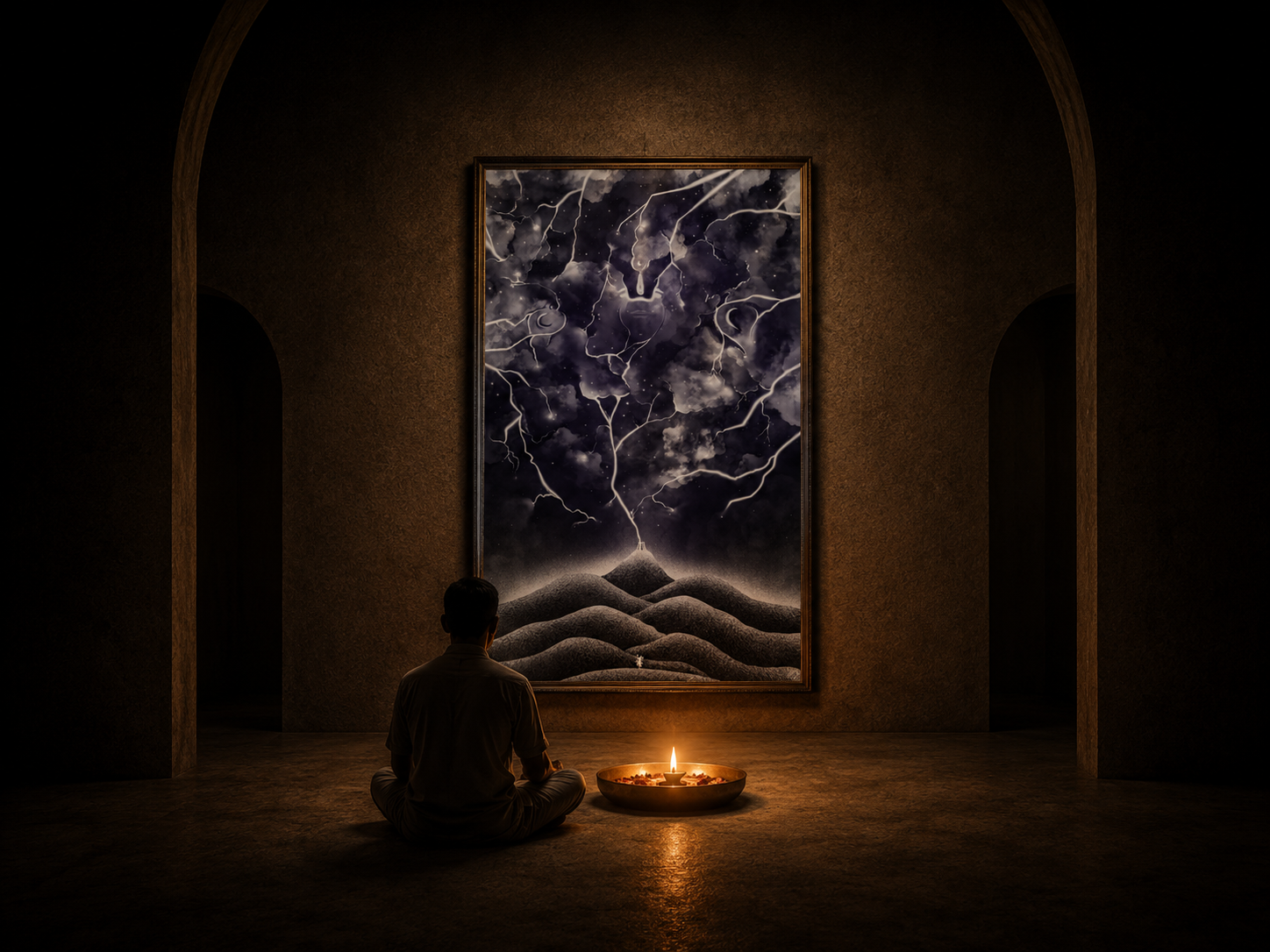
The mesmerizing artwork intricately captures the essence of Saint Annamacharya’s divine composition, “Okapari Kokapari” resonating within the soul-stirring Raagam Kharaharapriya.
Within the melodic tapestry, a profound verse unfolds: “Merupu Meeghamu Koodi, Merisinattunde” portraying the Lord’s ethereal beauty akin to a thunderstruck rain-filled cloud, radiating brilliance and shimmer, much like the electrifying dance of lightning.
Immersed in the celestial depiction, the divine symbols Shankam, Chakram, Naamam—and the revered countenance seamlessly emerge from the embrace of the cloud. This visionary tableau unfurls against the backdrop of the 7 hills, where Annamacharya stands at the foothills, gazing upon the spectacle he envisioned in his lyrical creation.
The 7 hills, symbolic of the intricate chakra system within both the human and cosmic realms, narrate a tale of transcendence. The canvas becomes a journey, guiding the observer through the ascending realms of consciousness, each hill resonating with spiritual significance. At the pinnacle, the divine board radiates with an otherworldly glow, transcending the boundaries of creation, illuminating the cosmos with the celestial light of the divine.
The painting is not merely a visual feast; it is a poetic odyssey, a hymn of ascent that echoes the sublime connection between the earthly and the divine, inviting the beholder to embark on a
journey of spiritual elevation.
The Genisis
ఒకపరి కొకపరి వొయా్యరమై
మొకమునఁ గళలెల ్ల మొలచినట ్ల ండె
జగదేకపతిమేన చ్లన కర్పరధూళి |
జిగిగొని నలువంక చిందగను
మొగి చంద్రముఖినూరిలోన నిలే ్పగాన |
పొ గరువెనెల దిగబో సినట ్ల ండె
పొరిమెరుగుచెకు్కల పూసిన తట పునుగు |
కరిగి యరుదేసల కారగను
కరిగమన విభునికి గనుక మోహమదములు |
తొరిగి సామజసిరి తొలకినట ్ల ండె
మెరయు ్రవేంకటేశు మేన శృంగారముగను |
తరచైన సొ ము్మలు ధరియంచగ
మెరుగుబో డి అలమేలుమంగయు తాను|
మెరుపు మేఘము గూడి మెరిసినట ్ల ండె
Note:
These texts are the foundation from which the paintings were born. Spending time with them through contemplation and meditation can help the deeper layers of the artwork reveal themselves.
The paintings are not meant to be understood only visually, but experientially. Like all sacred art, they unfold more completely when approached with inner practice and reflection.
For a fuller understanding of the symbolism and spirit behind the work, please take the time to read, contemplate, and sit with these texts.
"I didn't want to draw God. That already exists in high fidelity. The idea was — when you see a cloud, can you relate to the divine? Learn to see it outside."
Spatial Effect
Tirumala is the most serene painting of the series — the most tender, the most gentle, the most frail. It is friendly blue. It is made for the awareness of the background — the volume around it expands into a quiet, abundant presence. It belongs in hall spaces and dining areas above all: places where life gathers, where food is shared, where the body settles and the mind softens into ease.
Fundamentally, this painting is grace itself — grace bundled into a painted form and brought into the space it inhabits. Where Rudram brings intensity and stillness, Tirumala brings grace and ease. Where Rudram concentrates, Tirumala opens. In Tirumala, there is nothing called Daridra — scarcity does not exist. The one who wants food has food. The one who wants money has money. The one who wants knowledge has knowledge. Everything is already there. The painting holds this truth quietly on the wall, so that the room itself begins to remember it.
A room living with this work becomes a room steeped in grace — aware of its own abundance, attentive to the overarching presence that holds everything, mindful of the riches that are always already given and sitting tenderly behind the everyday.
Effect on The Person
The painting trains the eye to see the Lord through the elements of nature. The calendar version of God already exists in high fidelity — drawn endlessly, prayed to daily. Tirumala does the quieter, more elemental work. It asks the viewer to look at the next cloud, the next strike of lightning, the next stretch of dry land, the next flowing river, and find the divine already placed there. The Lord moves through the elements; the painting only points to where he is already standing.
This is the elemental play of Vishnu — present in the rain that fills the cloud, in the light that splits it, in the hill that rises beneath it, in the water that runs below it. The composition does not draw the Lord directly. The cloud is drawn, the lightning is drawn, the hills are drawn — and the form emerges within them. Anyone drawn to Venkateshwara Swami will recognise this painting immediately, but its work is wider than that single recognition. It is grace, made visible.
01 Recognition of the Lord in the elements
After living with the painting, the next thunderstorm begins to look different. The next rain-filled cloud carries a silhouette. The next flowing river, the next dry stretch of earth, the next strike of lightning — each begins to feel inhabited rather than empty. The temple stops being a single mountain in a single place and becomes the elemental world itself. Why create an image of God that you pray to daily when there is enough outside? Learn to see it outside. That is what the painting silently teaches.
02 A mapping of the Seven Hills ot the seven chakras
The seven hills are the seven chakras, the seven swaras, the seven dimensions of the system. Annamacharya stands at the lower bed, which is Muladhara, looking up at Sahasrara, where the Lord resides. The lightning is the first descent — from the crown to the base, from the cosmos into the body. The painting traces this map silently. Those who sit with it begin to feel their own body as a mountain, with summits and valleys, with hills to climb and a peak waiting at the top.
03 The Buddhic Plane reveal
Megham is emotion. Merupu is intellect. When the two strike together — the waters of the earth meeting the fires of the cosmos, Buddhi and Manas hitting at the right reverberance — the first golden light is born. Lightning is not crystal white. It is golden white that only shimmers as crystal to the eye. This is the Buddhic plane revealing itself inside the cloud. The teaching hidden in the silhouette is not to dismantle emotion, not to detach from it, but to be involved with a sense of disconnect when indeed — to feel and think together, with neither one consuming the other.
04 A grateful awareness of abudance
This is the painting's deepest and most tender gift. It is not for those who need to be reminded that abundance exists — it is for those who already feel it, and who want to live inside that feeling with reverence. The painting holds, on the wall, the prayerful posture of a person who knows the Lord has given everything: a roof, a meal, a body, a breath, a path, a people. Living
What it Does for Specific Kinds of People
01 Anyone drawn to Ventakeshwara, Krishna, or any aspect of Dattatreya
Both Venkateshwara and Krishna are Neela Megha Shyam — the dark rain-filled cloud. Both are aspects of Datta, the amalgamation of three forces, the seven-ray system embedded into itself. Both ask for the same thing: devotion. For anyone whose practice is rooted in any of these forms, this painting is the closest visual to their inner experience.
02 Researchers and people doing deep mental work
The ones who want grace — into any kind of grace — Tirumala is the work. The work itself is grace gathered into form, the abundance face of the divine, the one that gives without measure, the one that holds the riches of everything and asks for nothing but the willingness to receive.
03 Those who already feel abundance and want to live in gratitude for it
For those whose lives are full — full of work, full of family, full of meaning, full of means — and who want a daily presence on their wall that lets them feel that fullness as a gift. The painting holds the prayer of thank you without needing words. It strengthens the wish that this abundance may continue, so that the giver of food may continue to feed, the holder of resources may continue to give, the one who has plenty may continue to share.
04 Hall spaces and dining areas of homes
These are the painting’s natural placements. The dining area especially — where the family gathers, where food is shared, where the day’s work is set down. The painting belongs where life unfolds in its ordinary fullness, where the act of eating becomes a quiet act of gratitude.
The Essence in a Nutshell
Tirumala gives you, on your wall, the answer to two questions held quietly together: can you see the Lord in the elements? — and can you live gratefully inside everything you have already been given?
The painting does not depict God. It depicts the elemental play of Vishnu — the Lord moving through cloud, lightning, hill, rain, and the dry earth between them. Living with it, the eye slowly learns to find the same recognition in the world outside the frame. The cloud overhead, the river below, the rain that falls without asking — each becomes a small temple. The world becomes the place of worship it always was.
And in that recognition arrives the second gift: the steady, grateful awareness that everything in this life — the meal, the home, the body, the hour — has already been given. The painting holds this gratitude on the wall like a lit lamp, asking only that it be felt, lived in, and passed on through service.
Fundamentally, the painting is grace. Everything else — the abundance, the awareness of background, the deepening of devotion, the tender mapping of body to mountain — emerges from this single foundation. Grace gathered into form, set on a wall, and quietly given to the room.
"This is about recognition. About the moment nature stops being background and becomes the thing itself. About learning to see what was always already there."