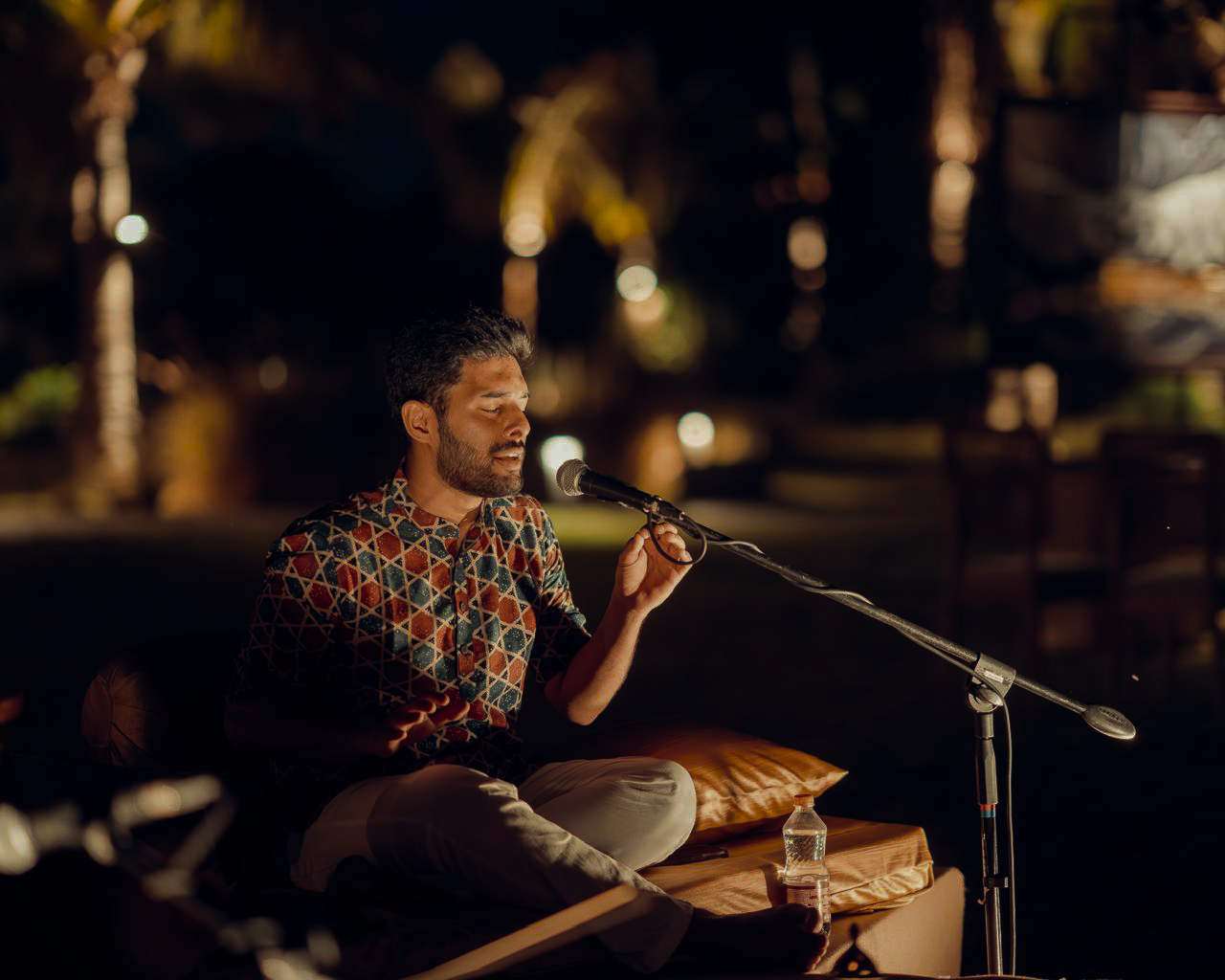
The Artist
Saathwik Yadavalli is the artist behind these works. But the word artist sits a little uneasily onhim. By his own admission, drawing was the only thing he was good at as a child.
It was his entire identity through his early years — the one subject he could pass, the one skill he could fall back on, the one place where the world did not ask him to be something he was not.
What he became through that drawing was something else entirely.
“The answer is in the practice. It's not in anything else."
The Beginning
He was not trained in the classical sense. He did not study art with the intention of becoming a painter. The early canvases were almost accidental — exercises in a form he had not yet understood, beginning with no theme, no plan, no diagram. He simply began. The hand moved.Something arrived on the page that he had not consciously composed.
What he did have, from very early, was a sustained inner practice. It was not prescribed as a path. It was something his body insisted on. He would sit with it for long stretches, sometimes for hours each day, sometimes through fasts that lasted into the next morning. The practice did not yet have a name in his mind, and it did not yet have a direction. But it was building something underneath the surface.
The earliest paintings emerged out of that ground. They were not designed. They were discovered. He would begin with a vague image — twenty or twenty-five percent of what the final painting would become — and the rest would arrive in the process of working. He once described the experience as walking into a black room. Someone shuts the door behind you.
You stand there in the dark, and at some point, someone switches on the light, and the painting is already there. That, more than any technical description, is how the early work happened.
And then a discovery arrived that he could not explain away. One of those early paintings, made with no plan and no reference, turned out to match — point for point, in numerical precision — the description of a sacred text he had never read. Sixty-four lotus feet folding into a twelve-petal lotus. A main figure on a yellow base. A cave with sixty-four outlines. Sixteen separate checkpoints, all accurate. He had not seen the text. He had not been told the structure.
He had simply painted what was arriving, and what arrived turned out to be something that had existed long before him. That moment did not give him a theory. But it gave him permission to keep going.
The Practice
What followed was years of quiet experimentation. Painting after painting, each one made under conditions of deepening involvement, each one demanding more from the body than the last.
He was not collecting techniques. He was learning, painting by painting, how to contain what was coming through. The early works spilled outward, almost dangerously, into the rooms they
were made in. The later works learned to hold their intensity within the canvas itself.
Over time, the work matured. The paintings could be made calmly, in a single seat, without disturbance to the people around. He had arrived at what would become the operative trinity of his approach: practice, perception, expression.
A sustained inner practice produced a heightened perception. That perception, when it crossed a certain threshold, demanded expression — through art, through music, or through both at once. The three were inseparable. Take any one away, and the work stopped. Hold all three steady, and the work moved on its own.
His method, by then, had become deceptively simple. Carry a question. Do not chase its answer. Park it, practice pressingly, and let the painting answer it on its own time. The answer is in the practice. The painting would arrive when it was ready, and not a moment before.
The Approach
His relationship with the work is unusual, and it shapes everything about how the paintings function. He does not believe he is the source of what comes through them. He describes himself, when pressed, as a translator at best — and even that word he uses cautiously.
The more accurate framing, in his words, is that he has been given a free pass to do this work. Permitted, allowed, lightly held. Not the maker, not the originator, but the one who happened to be standing where the work decided to arrive.
This posture is not a humble pose. It is a working principle. The moment he begins to believe that he is the one doing the painting, the painting stops. The flow closes. The intensity recedes.
Only when the thought is dropped does the work resume. Over time, this rhythm has trained him into a different relationship with creation itself — not as an act of will, but as an act of allowance. The corollary to this is that he does not chase meaning. He deliberately avoids learning the meanings of the texts and concepts that surround the work until the work itself is finished. Why pollute the mind by knowing when you are not yet ready? When you are ready, you will know. Meaning, in his view, is a derivation of language — and language is downstream of truth.
If the truth is in the work, it will reveal itself in its own time. Forcing the meaning earlier only corrupts
the reception.
The Body of Work
What runs through all of his paintings is a single quiet conviction: that art, properly made, is a working object. Not a decoration. Not a self-expression. But a yantra — a piece of sacred geometry, animated by intent, capable of doing work in the space it inhabits.
The works carry grace. They absorb dishti. They protect and amplify. They are beautiful, yes, but the beauty is the surface. The function is what lives underneath. The monochrome, the symbolism, the geometry, the placement of every element — none of it is decorative.
Every choice in the work has a reason. And those reasons, more often than not, were not designed in advance. They were discovered in the act of painting, and only understood later when the meaning revealed itself.
Each work takes its own time. Each one demands its own discipline. Each one humbles him in its own way. And each one, once complete, becomes an object that continues to do its work long after his hand has left the canvas.
The Larger Vision
Saathwik does not present himself as a unique figure. He says this directly. There are, in his view, many more capable artists than him — people whose work could do far more than his does, if only they had the conditions in which to make it. Most of them do not have those conditions. Most of them have to choose between exploring their work and surviving.
This is what he intends to change. His larger vision is the building of cultural spaces for artists - places where they can grow, create, and express the way he was given the opportunity to. Spaces that do not ask the artist to justify themselves before they have begun.
Spaces where food, shelter, and time are taken care of, so that the work itself becomes the only thing the artist has to attend to. Just sit. Practice. Make. Wait until something opens. Continue. He believes this kind of space is what is missing. He believes that if it existed, the country - and the world - would be richer for what came out of it.
The opportunity that allowed his own work to arrive was, in his understanding, a rare gift. He wants to make that gift ordinary. He
wants the conditions that produced his work to become the conditions in which a generation of artists can produce theirs.
The paintings, in this sense, are not only a body of work. They are a beginning. A foundation laid quietly, so that what comes next can stand on it.
“I know how to recognize when the world goes quiet. That's when I know I'm looking at something real.”